Tuesday, February 11, 2014

Let's Talk About Race

Let's Talk about Race is written by Julius Lester and illustrated by Karen Barbour.  It was published in 2005 by Amistad, which is part of HarperCollinsPublishers.

I thoroughly enjoyed this book, but have mixed feelings about who the book would be best suited for.    The information and insight within the book is incredibly valuable, especially in today's society.  In a world where everyone is trying so hard to not be racist, yet so many events turn into "being about race" this book could open the eyes of many, and help people understand that, although there are often cultural differences between people of different races, in the end, we are all pretty similar.  That being said, children rarely have a problem with someone because of race.  Children are seen holding hands, hugging, talking with, laughing with and playing with other children of other races all of the time.  It isn't until they get older, and are exposed to the thoughts and ideas of older children and adults that things start to change.  So, although I loved the book and loved the message within the book, I feel as though it would be appropriate for upper grade level students.  It would be appropriate for people who have forgotten what it was like to enjoy someone else for who they are, and not for the color of their skin.

I thought the way the author "spoke" right to the reader was brilliant.  He told the reader about himself, and asked the reader questions.  It made me feel as though I was having a conversation with the author, and not just reading his book.  When he wrote, "Some stories are true. Some are not. Those who say 'My race is better than your race' are telling a story that is not true", he hit the nail on the head as far as pointing out why we have problems with race to begin with. The preconceived notions that are passed down are troublesome for our country and society.  Thinking about that, this book could be appropriate for younger students, as hopefully a discussion can happen to help them think for themselves and not believe what a parent or older friend is saying about people of other races.

I don't feel as though this is a typical multicultural book, as they were discussed in our chapter and in class.  When I think of a multicultural book, or a diverse population book, I think about a picture book with characters that are from a culture outside of the Anglo-Saxon characters that are usually depicted in our storybooks.  This was more of a book about helping people understand our similarities, and not about one particular group of people.

I was drawn to the illustrations no the first page of text. The children and adults interwoven throughout the tree was a beautiful image to me.  There were many curves within the branches, and horizontal lines, which made me feel at peace when I first began the story.  I thought the blue butterfly was a nice touch.  It is the only color on in the illustration, but it's a muted color, which allows for a feeling of calmness.  Beyond the first page, I wasn't reeled in by the illustrations.  It appears that he has an expressionistic style of drawing, which I have realized, it not to my liking.  There were warm colors throughout most of the book, which was probably done to ensure a sense of peace while reading a book that could make you angry, since not everyone will agree with the message in the book. There is a page near the middle of the book that is bright pink.  It states, "Why would some people say their race is better than another? Because they feel bad about themselves. Because they are afraid. Because."  I think the bright pink is perfect for this, as it awakens the reader and makes them think about what is written here.  It makes them realize that what is said on these pages is part of the problem, and maybe, just maybe, if you feel some stirring within you on these pages, you will start to help solve the problem.

I could see myself reading this book with my children and my students.  It is important for them to understand that we should choose our friends because of the way we are treated, or the characteristics we find valuable, and not the race of the other person.


faith

faith is written by Maya Ajmere, Nagda Nakassia and Cynthia Pon. It's photographs are submitted many photographers around the world.  It was published  by Charlesbridge in 2009.

What a beautifully constructed, enjoyable book.

 faith is a nonfiction book that looks at religions around the world through beautiful photographs. This book is part of the Global Fund for Children Books, (www.globalfundforchildren.org) which is a nonprofit organization in Washington, D.C. It's purpose is to "advance the dignity of children and youth around the world" and "teach young people to value diversity and help them become productive and caring citizens of the world." (back endpaper)

I am not much of a religious person.  I have my beliefs and raise my children in a way that any questions that they have are answered. If I cannot answer them because of my lack of religious background, I find someone who can.

Because of my personal background and beliefs about religion, it gave me great happiness to see this book focusing on the similarities between us all, and not the differences.  I thought they way that the text explained how all religions were similar -- "We show our faiths through what we wear...We celebrate with festivals...We visit holy places" -- was smart.  First bringing the attention to how our religions make us similar, and then going to the pictures to explain the differences allows the reader to relate to the text, no matter the beliefs.  My favorite picture is where the Buddhist monk is sitting with a class of young Christian children at Sunday School in Sri Lanka.  This draws me in because it is the first photograph of people of different religions enjoying each other's company.  The accompanying text says, "We listen to and learn from others."  I feel as though this should be the basis in life, no matter what we are talking about.  Everyone has a difference of opinion on practically every topic out there, but if we could listen and learn from others, it would make the world a much more peaceful place.

Each page had photographs that were on a background of bright color.  The photographs show people happy in their religion, enjoying the traditions that are sacred within their beliefs.  This allows for the reader to have positive feelings towards what they see in the photographs, whether they also follow that religion or not.

I think this would be a good book to share with students in the classroom.  Students want to bring up religion often, and talk to you about what they believe.  Although teaching a specific religion in public school is not acceptable, this book would be a fantastic catalyst to broaden students' knowledge about all of the religions available.

Wednesday, February 5, 2014

Diary of a Wimpy Kid: The Ugly Truth

Diary of a Wimpy Kid: The Ugly Truth was written and illustrated by Jeff Kinney. It was published in 2010 by Amulet Books.

 
Over the years, I have seen this books from the Diary of a Wimpy Kid series being carried by students in the upper elementary school grades.  They have talked about how much they liked the books, how funny they were, and how goofy they thought Greg was, but I never really got it.  There was nothing like this series when I was a kid and my personal children aren't old enough to read this series yet, so I never really looked into it. Sadly, I think I was a book snob when it came to this series.  I like chapter books. Regular chapter books. I didn't think this had a place in the classroom. Now I wish I had.  I would have had more of these in my classroom.  I would have been shoving them into the hands of my avid readers and my reluctant readers, because I believe that everyone in the classroom, in some way or another, would be able to relate to this book. It is such an easy read, that even the students who have reading difficulties could find success with this book. Half of the page is taken by simple pictures, depicting the antics Greg and his family and friends are doing, while the other half is a 'handwritten' journal entry. Kids would be able to fly through this book, and realize, that they do have the power to read a lot in one day. They have the power to realize that Greg is not so different than they are and that they can relate to the challenges he has, the stunts that he pulls and the fights that he has with his family and friends.  

Greg is a typical middle-school boy.  He is not too popular, not the best student, not all that athletic. He doesn't have many friends, although he thinks he is better than the friends he does have.  He has an older brother that picks on him and makes him do his chores, and a younger brother that is babied, and annoys him on a regular basis. In Diary of a Wimpy Kid: The Ugly Truth Greg begins by telling us that he is no longer friends with his long time best friend, Rowley. He talked about how Rowley wasn't good enough for him anymore and needed to find a replacement best friend.  This made me think that "The Ugly Truth" of this book was showing how awful Greg had treated Rowley.  I was not correct about that -- "The Ugly Truth" was just the truth of a middle child middle-schooler who was struggling to figure out how to get through life on easy street. Although there are many, many events he discusses in the diary, there is a logical time sequence and he references several events many times throughout the book.

One of my favorite stories that he goes back to in his diary is worrying about having "the talk" with Grandma at his uncle's wedding.  He knows he has gotten to the age of "the talk" and is completely embarrassed that this older woman is going to sit him down and talk about so many personal things.  In the end, it wasn't quite as embarrassing as it could have been, and he got out if it unscathed.  It reminded me of when I was a kid and had to have any type of talk with a parent or other family member.  I'm a pretty closed off person, so I never liked to have the big talks with people.  I understood his embarrassment, and possible fear of sitting down with his grandma. Like him, I knew the talks weren't the end of the world, but it was definitely not something I was looking forward to!

At the end of the book, Greg does makes with Rowley.  Greg says that he  might as well be friends with Rowley, at least until high school, because he looks like he is going to be pretty big and he can stick up for Greg if someone bullies him.  I'm not a huge fan of the reasons behind Greg's friendship with Rowley.  I think that he is a bad friend, and I realize this is a fiction story, but I feel as though it can give students who read it the idea that treating a friend like this is okay.  That part of the book is my only complaint about this book.  I want to make sure that the students in my class, and my school, are good to each other, and I don't like that it shows Greg as a selfish friend who is only out to help himself.  When I talk to kids who read this book, that is something I would definitely talk about and see how they feel about Greg's friendship with Rowley and if they agree with the way Greg acts. 


Sunday, February 2, 2014

Oliver's Tantrums

www.barnesandnoble.com
Oliver's Tantrums is by Boriana and Vladimir Todorov. It was published in 2011 by Simply Read Books.

I. Loved. This. Book. 

When I saw Oliver's Tantrums sitting on the top shelf at the library, I thought to myself, "I need to read that book." Although it is a picture book, it looks as though they took photographs of the people in the book and created the pictures around the photo.  The photo of the little boy looks similar to my oldest son, so I was drawn to the book.

This book is about a young boy, Oliver, who is upset because his mother is giving the new baby, Penny, more attention and is not spending time with him. At the beginning, he asks her several times to play with him and she can't because of something going on with Polly. He has a few tears, but it isn't until he found the "tantrum balls" in the attic that he was able to change anything.  There were three balls -- water, food and toys.  When he got upset, he would throw a tantrum ball at his mother to get his way.  At first, it was the water ball (tears), which worked for awhile and then his mother was able to figure out how to stop those tantrums.  After that he used the food ball (throwing food).  Again, this worked for several weeks before mom was able to stop the tantrums.  Finally, he threw the toy tantrum ball (when his toys got broken by Polly).  It didn't take long for mom to get rid of this tantrum as well.  Finally, at the end, he tried throwing all of the tantrum balls at once, when mom explained he would have to go to school.  He yelled and screamed, worried that she didn't love him anymore and only wanted to get him out of the way so that she had more time with Penny.  Mom was able to diffuse this tantrum by telling him how much she loved and missed him and that she would soon not be as busy with Polly.

Throughout Oliver's Tantrums, the illustrations were very dark.  They show the upsetting nature that it is for everyone when a child throws a tantrum, for any reason.  Illustrations, such as the spaghetti monster and floating food, jump out at the reader.  Many of the pictures appear real, with some drawing finished around them, so I looked into the illustrator.  He has a background in cinema animation, which is clearly shown in his work in this book. 

I thought that this would be a good book that any older child, but especially imaginative young boy, who feels as though he is left out because of a new sibling.  This could connect at any age, but I think would be appreciated (with discussion) by a kindergartner who is feeling as though his mom has sent him away to be able to be alone with the baby.  Many young kindergartners don't understand why, all of the sudden, they don't get to spend time at home, and this could be a real fear of theirs.  In this book, Todorov showed how the relationship between child and mother can change when another child is born, how an older child might feel about it, and how to deal with it.  She leaves Oliver with an understanding of how much his mother does love him at the end, so he is able to get rid of the tantrum balls for good.

Until, of course, Polly finds them a few years later...

Saturday, February 1, 2014

Sidewalk Circus

www.amazon.com
Sidewalk Circus is presented by Paul Fleischman and Keven Hawkes. It was published in 2004 by Candlewick Press.

Sidewalk Circus is an eye-catching wordless book about how the world around us can mirror the circus. 

When I first picked this book up and read the title, I thought it was going to be about someone, or several people, performing on the sidewalk.  I hadn't realized until I got home that it was a wordless book and that the pictures would tell the story of the performance.

The first thing I noticed when opening the book is that on the left side of the page, there are several people sitting at a bus stop, waiting to be picked up for their daily commute. Only one of the bus riders is a child.  She is who I focused on when 'reading' this book.  I tried to put myself into her shoes and experience it the way that she would.  Across from the bus stop was a theatre which announced the show and the acts that would be seen at the show.  There were also several shops and people walking through the street.

www.goodreads.com
Each picture in the book depicted the people on the street acting in a similar way as an act that would be seen at the circus. The little girl watched from across the street, mesmerized by the characters on the street.  I caught myself really studying the pictures before I read what they were supposed to be on the theatre board, so I could try to figure out what the girl was seeing. I could feel the joy that she had as she watched each part of the 'show' on the sidewalk. It was fun to think back to the times I have been to the circus, and try to imagine the real circus performers doing what the people on the street were representing. 

www.gatheringbooks.wordpress.com
The fact that the little girl is the only one enjoying the show, or even attending to it, speaks to the loss of creativity and fun in adults.  They are so wrapped up in being late, meeting others, or just being too unhappy to enjoy what is going on around them. The child's facial expressions change from wonder when the show first begins, to excitement when the woman is 'juggling' pancakes, to fear when the boys almost fall off of the 'trapeze' , to longing when she has to get on the bus and drive away.  I believe  they caught the emotions that run through us at a real circus perfectly.

After the bus took the people on to their next destination, new people sat at the bus stop.  Among them, was another child -- a boy who will now get to experience the adventure of the Sidewalk Circus.


Cat Heaven

www.goodreads.com
Cat Heaven is a book written and illustrated by Cynthia Rylant.  It was published in 1997 by The
Blue Sky Press.

If you haven't read my post about Cynthia Rylant's book, The Dreamer, you can read it here. I give you this link because it was a much more positive review of that book, and some of the thoughts I write about Cat Heaven may be better understood after reading the post about The Dreamer. 

As you may  know, I wasn't well acquainted with Cynthia Rylant before reading a couple of her books today.  I feel as though I am getting to know her better through her books, or at least one aspect of her life. What I have noticed in the few books I have read, is that she writes a lot about God and Heaven, although they are not explicitly about a Christian life. I had wondered if Rylant had a theme to her books, and it appears, from what I have read so far, that she does. She writes about religion and God within kid friendly books.

In the book, Cat Heaven, it goes through the thoughts of a cat when he enters Heaven and spends his day there. Rylant describes cat heaven as "a field of sweet grass where crickets and butterflies play." It sets up the reader to think about what cats would like in Heaven, and in turn, what people would like in Heaven. She continues to explain that all of the cat problems have gone away -- cats don't get stuck in trees because they can fly, there are toys and cotton mice all around, angels always waiting around to pet the cats, and whatever food the cat prefers is available whenever he is hungry.  The cat is content, needing, while it watches his old family, and then at the end of the day, can curl up with God. 

As I think about this book, I can't determine whether its purpose is to help children who have lost a pet, particularly a cat, or if it is supposed to help children who have lost a family member or a friend.  It parallels what is said about when humans go to Heaven -- there is no pain, you can do what you please and be at peace.  Although I understand her want in giving children a book that could help them through a difficult time, whether it is with an animal or human, this book did not particularly grab me. The illustrations were incredibly different than in the The Dreamer and they didn't hold my attention as well. They were more simplistic and silly, which may have been done to lighten the mood of the topic of the book. The illustrations in this book were done by Rylant, and as I looked through some of her other books, this appears to be her style of illustration.  I may not have liked it because I am an adult, and I don't appreciate the painted, simple pictures, like a child might. The illustrations match the text and are specific to what she has written. Although this book could be beneficial for a child who has lost a loved one (furry or not), I think that it would be difficult for a child who is not growing up in a religious household to understand the implications of the story. 

Overall, this was not my favorite book that I have read so far.  I may be someone who enjoys children's text with a little more complexity and story and someone who likes to see detailed illustrations which go along with the plot of a book.  Maybe I am too surface level and can't or don't think deeply enough about what has been written.  I'd love to hear your thoughts about this book, if you have read it.

Either way, I look forward to moving on to other books. 

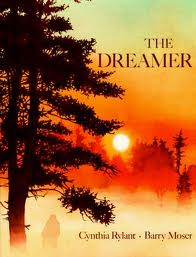
The Dreamer

www.betterworldbooks.com

The Dreamer is a book written by Cynthia Rlyant and illustrated by Barry Moser. It was published in 1993 by The Blue Sky Press.

In the past, when I read a book, I wasn't too preoccupied with who the author was. There have been books that I have loved forever, and books that are new to me, and I always thought it was a happy coincidence when I happened to love two or more books by the same author. (No offense to the books or authors -- I do the same thing will music and movies as well.) This is the first thing I thought about when reading Cynthia Rylant's The Dreamer. I knew of Cynthia Rylant but couldn't put my finger on what her books were. I didn't know if she had a theme to her picture books or if all of her books were about something completely different. I had to look them up to realize that, yes, I had read a few of her books throughout the years. The Dreamer was new to me.

The Dreamer is a book about a young artist who grew confidence in himself with each passing work of art he created. He started out creating a star, and we see the hand of a man cutting start out in the illustrations. He continues to dream, and as the artist he is, needs somewhere to place the stars, so he creates the sky. In my opinion, the illustrations look as though he has painted the sky on the walls and ceiling of a bedroom. At this point in the book, I started thinking about how this is how all kids feel. They want to try to do something, create something, share something, and they found success with what they did, so they try again. This time, what they try is a little more difficult, yet the succeed because they were willing to put themselves out there. In my mind, as I read, I thought about how this could lead to a discussion about creating in small steps, and continuing to move forward with the more you learn.

www.librarything.com
But then I turned the page. On the next page, Ryant writes, "By morning he had made an earth. Round and sturdy, full of bumps and chunks and ridges. It borrowed the light of the heavens and sat full of form and grace. The young artist, shyly pleased with himself, rested his back against a smooth ridge and gently closed his eyes." This is when I knew that The Dreamer was not about a child at all. Throughout the rest of the story, she tells of all the beautiful things that the young artist creates, first in his mind, and then in reality. With each turning page, I think my prediction of who the artist is has a greater chance of being true. On the last several pages, she writes, "The first young artist, still a dreamer, has always called them his children. And they, in turn, have always called him God.

With the prior knowledge I have, it only took me three pages to realize that the artist in this book was God. Her eloquent words to describe His dream made me picture Him in my head, imagining Him sitting back, thinking through how he would actually create our world. I believe it is a eye-catching, child friendly way to discuss God and how he created Earth.

Although I thought that this book was a good piece of writing, and it made me feel at peace with the beauty in our world, I do not know if it is appropriate for school, in isolation, and may be more appropriate for families to read together at home. When it was published, in 1993, it would probably not have been a big deal to read it within the classrom, but without getting into my own spiritual and religious beliefs, I have to say, that it could anger some parents if this were to be read at school, and books about other religions were not read as well. I do believe that all children can relate to what the artist is doing -- visualizing what He wants and taking the steps to create it, and I believe that is where I would take the discussion if I read this within the classroom. While I read it, the words and illustrations made me feel as though I could dream and have my dreams be fulfilled. It made me feel as though goals I have set could be accomplished and problems I had could be solved, and that is a feeling I would love to bring to a child's heart and mind.